This article was produced in partnership with In These Times.
When Mallory Tice’s husband, Ian, was booked into Baxter County Jail in December 2025, their three children missed him terribly. Any time the phone rang, their three-year-old son would ask if it was Dad. But it never was.
Ian was left isolated from his family thanks to Sheriff John Montgomery’s decision to shut off the phones in Baxter County Jail, a small facility in Mountain Home, Arkansas, that holds between 83 and 131 people per night. Since March 30, 2025, the people incarcerated in the jail have been unable to make calls to family or friends. The impact has been especially acute for those with young children, as the jail prohibits children under seven from visiting. As a result, Mallory’s two younger children were not permitted any contact with their father during his three-month pre-trial stay in the jail.
Mallory and Ian’s five-year-old daughter began waking up crying in the mornings, and their three-year-old son struggled with meltdowns and behavior problems. “He just doesn’t understand where his father is,” Mallory said at the time. “If he could talk to him and hear his dad saying, ‘Hey buddy, I’m still here. I still love you,’ I feel like he would understand better.”
Sheriff Montgomery decided to shut off the phones in response to 2024 Federal Communications Commission (FCC) reforms that lowered the maximum cost of phone calls from jails and prisons around the country. In a statement at the time, Montgomery wrote: “We regret that the Federal government took this step last year as we know [the phone shutoff] will place a hardship on families.” The removal of phone access fits within a longstanding punitive culture at Baxter County Jail. But its implications have traveled far beyond the Ozark Mountain county of 43,000. Last year, under President Donald Trump, the FCC used Baxter County’s phone shutoff as part of its justification for rolling back its own reforms.
In two orders walking back the reforms, the FCC suggested that Baxter County’s phone shutoff was part of a larger national trend, and that the lower rates may force other jails and prisons to cut off phone access. In federal filings, prison telecom companies made similar claims. But Baxter County is actually the only known county jail to have shut off access to phones in response to the reforms.
“In 2026, it’s unheard of for there to be no phone access in a prison or jail,” Bianca Tylek, Executive Director at Worth Rises, an advocacy organization that pushes the FCC to lower correctional phone costs, told Type Investigations and In These Times.
 Mallory Tice’s husband, Ian, with their children.
 Photos courtesy of Mallory Tice.
It’s not just residents of Baxter County like Mallory and Ian who are suffering. Millions of people around the country are now facing higher expenses to speak with their incarcerated family members and friends.
“We know that when incarcerated people can stay in communication with their families, there’s less recidivism. It makes it easier for reentry,” Anna Gomez, the lone FCC commissioner to oppose the 2025 rate changes, told Type and In These Times. “Think about the children, the parents of people who are incarcerated. To them, it’s a lifeline to their loved ones, and oftentimes these families are the ones that can least afford these very expensive services.”
An exploitative industry
Prisons and jails contract with correctional communications companies to operate their phone systems. The two largest companies—Aventiv (which does some business under its subsidiary, Securus) and ViaPath (formerly Global Tel Link, or GTL)—control about 90% of the $1.4 billion prison telecommunications industry.
Historically, prison communications companies have charged exorbitant prices to accept calls from incarcerated loved ones. In 2008, for example, the average cost of a 15-minute, in-state call was $4.41, and out-of-state calls were significantly higher. But in 2023, after decades of lobbying from prison reform advocates, President Joe Biden signed a law requiring the FCC to set “just and reasonable” rates. In response, the FCC unveiled new, lower, per-minute rate caps in July 2024, set to go into effect the following year. The announcement was celebrated widely by advocates and families of incarcerated people, who spend almost $4,200 a year on average communicating with, visiting, and supporting their loved ones.
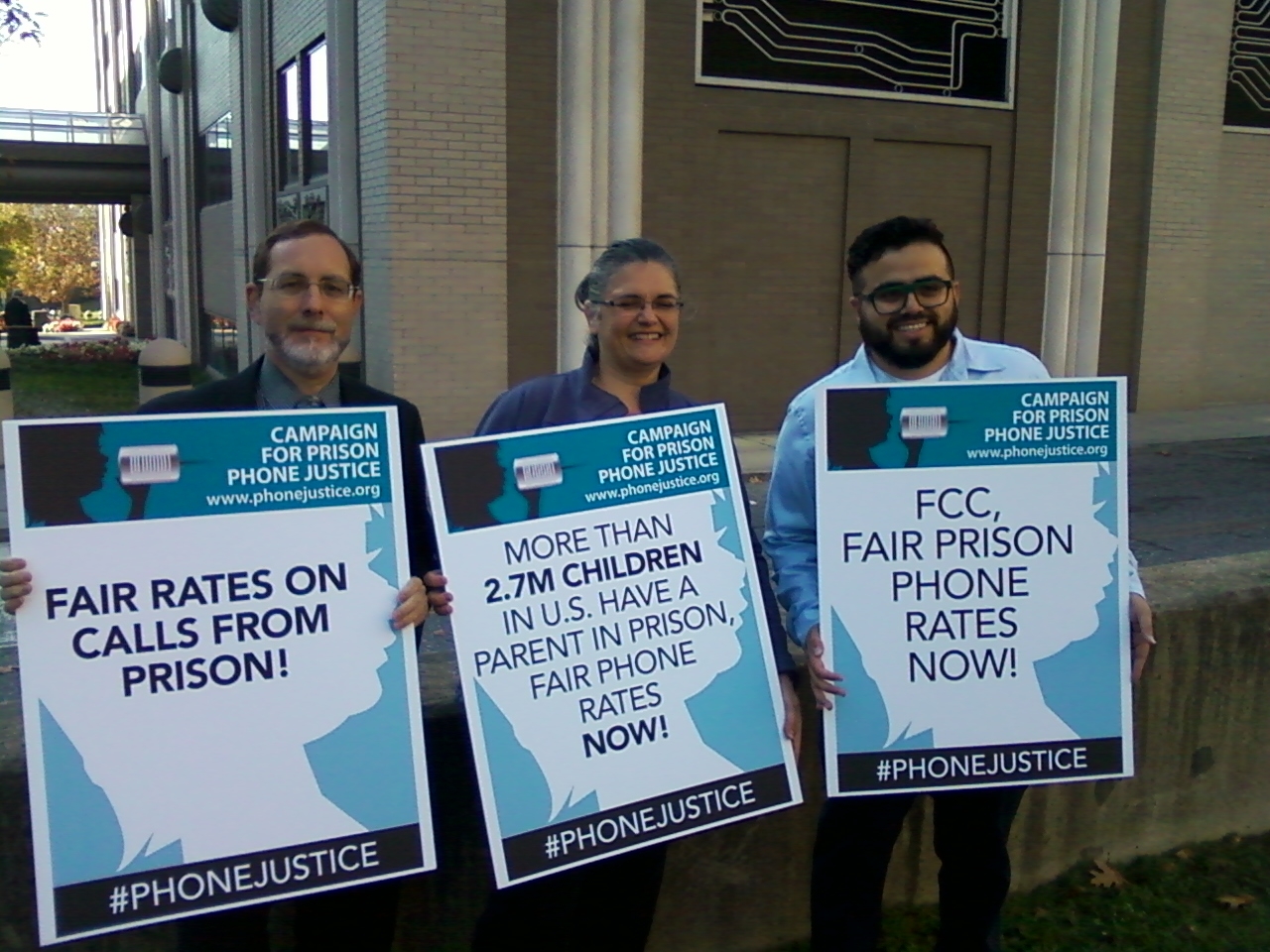
Advocates with the Campaign for Prison Phone Justice protest for lower rates for prison and jail phone calls in 2015. Image: Human Rights Defense Center
The new regulations also banned phone service providers from paying commissions, or a share of the profits, back to prisons and jails as part of their contracts. These commissions increase phone costs for families by disincentivizing prison systems and jails from negotiating lower rates.
Prior to the new rules, Baxter County’s contract with Securus specified that the company would collect the cost of calls made from the jail and pass along a percentage of the money to the sheriff’s office each month. According to contracts obtained by the Arkansas Times, from 2010 to 2021, Baxter County received 52% of all jail phone revenue from Securus; in 2021, Securus renegotiated the contract, reducing the county’s commission to 25%. These payments added up: From 2000 to 2024, Baxter County brought in an average of $12,600 in annual commissions from Securus, according to documents Type Investigations and In These Times obtained through a public records request.
The FCC’s ban on commissions apparently did not sit well with Sheriff Montgomery, who announced that without them, there would be no phones at all.
“It’s real simple,” Montgomery wrote to a Securus sales rep in a February 2025 email, obtained via a public records request. “If we’re not going to get a profit…we’re done.”
Sheriff Montgomery shut off the jail’s phones on March 30, 2025, two days before the FCC’s new rules were set to go into effect. In a statement announcing the shutoff, the sheriff’s office, which did not respond to requests for comment, blamed the FCC.
Meanwhile, correctional phone service providers like Securus and ViaPath petitioned the FCC to cancel or increase the new rate caps, pointing to Baxter County’s decision as an example of what could happen. “Facilities have decided to stop offering [phone access] altogether,” argued ViaPath in a presentation to FCC representatives and subsequent filing. Similarly, Securus and Pay Tel, another provider, wrote that “At least one correctional facility has publicly stated that it is ending access” to phone services and noted that some other facilities had warned of possible reductions in service.
These correctional phone service providers argued that the new rate caps meant they could no longer afford the recording and monitoring that prison and jail phone calls require for safety reasons. Instead, they say they would be forced to pass those costs on to facilities.
Despite these warnings, however, Baxter County appears to be the only one of the nation’s more than 3,000 jails to terminate phone access following the FCC’s decision. Type and In These Times could not find evidence of other county jails or state prisons so far discontinuing phone access.
Still, the FCC took notice. In June 2025, the three-member commission postponed the lower rates for two years; four months later, it issued higher interim rate caps. (Phone companies are still banned from paying commissions to facilities.) To explain the rapid reversal of its own policies, which had barely gone into effect, the FCC asserted that the 2024 caps were too low to cover costs associated with monitoring and surveilling phone calls. When announcing both the postponement and the higher rate caps, the FCC cited Baxter County’s phone shutoff as evidence of the need for higher rates. The FCC did not respond to requests for comment about the policy change.
But many of these security costs “should be funded out of state and local budgets, not placed on the backs of the vulnerable families of incarcerated people,” Commissioner Gomez told Type and In These Times. She noted that many jails and prisons systems have managed to price their calls below FCC rate caps without issue, and that several states and the federal Bureau of Prisons have even made prison phone calls zero-cost for families. “I continue to believe that law enforcement should foot the bill for security costs that have nothing to do with making the call.”
More expensive phone calls across the country
Under the current rules, state prisons can now charge up to 11 cents a minute (the 2024 cap had been six cents), and small jails like Baxter County can charge up to 13 cents a minute (compared to the 2024 cap of nine cents).
As a result, in various states and counties, people are now paying more to accept calls from their incarcerated loved ones than they would have if the caps remained in effect. As of early this year, 14 state prison systems charged more than six cents a minute for an in-state phone call, according to data collected by Worth Rises. More than 800 county jails now charge more than nine cents a minute.
Richard Fox, writing for Prison Journalism Project, reported that his Alabama prison initially decreased prices in accordance with the 2024 caps, only to raise them again in 2025, bringing the cost of a 15-minute phone call from 80 cents to $1.30. At a jail near Denver, phone prices more than doubled, jumping from seven to 15 cents a minute under the current rules, according to contracts reviewed by local television station 9NEWS.
These increases may seem insignificant at first glance, but they add up quickly for incarcerated people and their loved ones. Worth Rises estimates the current rates will cost families across the country an additional $215 million each year, compared to what they would have paid under the reforms the FCC passed in 2024.
“As a person managing a serious heart condition and currently filing for disability, these costs are a major hardship,” a man whose husband was incarcerated in a Kentucky jail wrote in a January FCC comment. “Staying connected to my husband is vital for his rehabilitation.”
“My 19-yo incarcerated young friend earns $0.40 per DAY for the labor he performs in prison,” a woman wrote in another comment last October. Yet, she noted, a 15-minute call “of horrendous quality” from his North Carolina prison costs $2.16. “His wages will pay for a SINGLE phone call each week, though of course he must also spend this money on items from the canteen he desperately needs….These high expenses help ensure that my young friend is cut off from the support and love from his family, so his relationships with them suffer. He will have less familial support when he returns to society because he can’t afford to keep in touch with his family on a regular basis.”
Meanwhile, in Baxter County Jail, the lack of phones has meant no family contact whatsoever for some.
“My [daughter-in-law] was recently in that jail… I live 800 miles away and with no phone rights, there was no way to communicate with her to even find out what happened,” explained one person in a message to Type Investigations and In These Times. The incarcerated woman’s husband was banned from stepping foot in the jail due to a 20-year-old felony conviction. “I wrote letters. Guess what, they don’t allow those either…Seemed like my son and I were the ones being punished in this case, as we had no way to check on her. All we could do was sit and worry.” The sheriff’s office did not respond to requests for comment about the communications restrictions.
“If you’re an indigent inmate, for instance, and you come from another state or another county, they won’t give you postcards for several weeks,” Zachariah Zelk, 45, who was incarcerated in the jail at the time, alleged in a deposition for his 2025 lawsuit against the jail. “They don’t let you call anyone to notify them of your whereabouts.” Incarcerated people, he alleged in a legal filing, “must write a ‘phone request,’ which is denied if you wish to contact friends or family! …Any phone calls to attorneys or legal counsel that are approved must be made in the presence of jail staff and are not private for attorney client privilege.”
In a filing, jail staff denied his allegations, writing: “Generally…officials place themselves in a position where they may visually monitor inmates making telephone calls but cannot hear the entirety of the conversation.” The lawsuit was ultimately dismissed when Zelk missed filing deadlines. At least one other lawsuit echoes Zelk’s claim that attorney calls are not private. The sheriff’s office did not respond to requests for comment about the allegations.
Sheriff Montgomery stands by his decision to remove phone access. “I wish people would worry as much about the victims of the crimes that these criminals committed as they do about the criminals,” he said in a 2025 interview on KTLO, a local radio station, when asked about turning off the phones. “All we want to do is concentrate on the criminals. And again, you got there because of behavior you did.”
The FCC’s about-face
The about-face at the FCC seems to be due, at least in part, to changes in the commission’s makeup and priorities between the Biden and second Trump administrations. In 2024, all five commissioners—three Democrats and two Republicans—voted in favor of the reforms. Brendan Carr, a Republican appointed during the first Trump administration, expressed some concerns, but ultimately supported the lowered rate caps.
But by 2025, the FCC was down to just three members, with two vacancies. This time, Carr, now FCC chair, voted to suspend the caps in June and to issue higher interim caps in October. The lone Democrat, Gomez, dissented, calling the rate increase “indefensible” and “an egregious transfer of wealth from families in incredibly vulnerable situations to monopoly companies that seek to squeeze every penny out of them.” She noted that—despite claims that the 2024 regulations made phone services untenably expensive—Baxter County Jail was the only facility cited in the FCC order that actually removed phone access.
Anna Gomez, the lone FCC commissioner to oppose the 2025 rate increase, called it “indefensible” and “an egregious transfer of wealth from families in incredibly vulnerable situations to monopoly companies that seek to squeeze every penny out of them.”
Carr, who wrote the FCC chapter of Project 2025, has politicized the commission during the second Trump administration, launching a deregulation initiative, and repeatedly seeking to deny license renewals to broadcasters over alleged bias against Trump. Carr wears a golden pin of Trump’s face, and has a mug portraying himself as a pitbull on Trump’s leash.
The commission also faces continued pressure from prison phone companies and sheriffs associations, which fiercely protested the 2024 regulations and the continued ban on facility commissions. The FCC has been inundated with filings from individual sheriffs around the country and law enforcement groups like the National Sheriffs’ Association, which wield significant lobbying power.
“[The FCC] reversed itself extremely quickly,” Commissioner Gomez told Type Investigations and In These Times. “It’s not like we had years of experience with understanding what the effects of these lower caps were…The commission gave providers everything they asked for…Despite the fact that keeping families connected saves lives, strengthens reentry, and supports safer communities.”
The FCC did not respond to requests for comment about Gomez’s analysis.
A number of groups have sued the FCC—some opposing the 2024 caps (such as Securus and the National Sheriffs’ Association), and others opposing the 2025 interim rate increases (mostly advocacy groups supporting incarcerated people). These various suits have been consolidated in one ongoing case in the U.S. Court of Appeals for the First Circuit. Groups on each side are currently filing briefs with the court, either arguing for or against the 2025 order. The court’s ruling, which is expected in 2027 or 2028, could potentially strike down aspects of the 2025 order and send it back to the FCC to adjust accordingly, according to a source involved with the lawsuit.
Unusually harsh policies
The lack of phone access in Baxter County Jail is exacerbated by other policies that make family contact difficult. Visits are permitted only once per week during limited hours. And children under seven, like Mallory and Ian’s children, are prohibited from visiting.
Andrew Macey and his wife have both spent time in Baxter County Jail. When she was jailed earlier this year, the lack of calls and letters made communication difficult. She was only allowed a single 30-minute visit on Fridays, he said, which he wasn’t always able to make. “Don’t get me wrong, it’s great getting to see my person,” he said. But it was hard to hear each other shouting through a glass window alongside other visiting pairs.
People in the jail are only allowed to send and receive mail in the form of plain white postcards. In 2017, the Human Rights Defense Center (HRDC), a national nonprofit, sued the jail after the group’s mailings were rejected in the jail’s mailroom. In 2023, a federal judge ruled it was unconstitutional for Baxter County Jail to deny HRDC’s publications.
In a radio interview on KTLO, Sheriff Montgomery noted that, while the ruling forced the jail to revamp its policy regarding printed publications from organizations like HRDC, its rule banning personal letters and other non-postcard mail “is not going to change.”
In a February FCC filing, Worth Rises criticized Sheriff Montgomery’s “long track record of antagonism and retribution directed at incarcerated people in his custody.” But Montgomery has stood by his policies over the years, stating that jail is not the Holiday Inn. “They should be treated as what they are…inmates,” he wrote in an essay published on the Sheriff’s website.
Beyond difficulties in communication, people in the jail describe poor living conditions and threats of retaliation. “The jail administrator and sheriff made it known ‘we are here for punishments,’” Mark Pinkston, then a pre-trial detainee, alleged in a 2025 lawsuit. “I was warned by inmates that [the lieutenant] will ‘make it hard on you’ for filing grievances or complaining so I feared filing them.” In a legal filing in response, jail staff denied that people face retaliation for filing grievances. The case was ultimately dismissed, because Pinkston missed filing deadlines after his address changed, presumably because he was no longer at the jail.
In other lawsuits filed last year, several incarcerated people alleged that the jail does not issue underwear with the standard uniform, so those who can’t afford to buy their own are left naked while their clothing is in the laundry. (In a legal filing, jail staff confirmed that this is the case: “While inmates’ clothes are being washed, they may cover themselves with blankets and lay on their mats if they choose to do so. Boxers and socks are not provided to inmates as part of the… uniform.”) Many people describe sleeping on ¼” thick mattresses that contribute to back pain and injuries. Sheriff Montgomery described the jail’s menu in an essay as oatmeal, bologna sandwiches, beans, and cornbread, 365 days a year. “It’s the same thing over and over again,” said Macey.
“The jail administrator and sheriff made it known ‘we are here for punishments.’”
Lawsuit filed by a pretrial detainee in the Baxter County Jail
During Macey’s stay in the jail, he said, he never went outside. To pass the time, he and others in his unit would “read the same books over and over again. Talk. We’d sleep until about noon, or at least as far as we could.”
The sheriff’s office did not respond to requests for comment about conditions in the jail.
“Jail and prison are punishments, but at the end of the day, it’s also kind of supposed to be rehabilitation,” Macey said. “How does it make anybody want to do better, not being able to just feel human?”
A new sheriff
After more than 20 years in office, Sheriff Montgomery did not seek reelection this year. In the Republican primary, Montgomery endorsed Brian Davis, who worked in his Sheriff’s Office for 14 years. Davis ran on a tough-on-crime platform, and specifically said there was no need to change the menu in the jail. But Davis was decisively defeated by Mark Hollingsworth, who spent three decades with the Arkansas State Police before serving as chief deputy sheriff in neighboring Marion County. He will run unopposed in November. Hollingsworth did not respond to requests for comment on whether he will restore detainees’ access to phones, which have now been shut off for 18 months.
Mallory’s husband was sentenced and transferred into the state prison system in March. After spending two months in an intake facility, where she says he was still unable to make phone calls, Ian was ultimately placed in a prison in the southern part of the state, four and a half hours away. “I’m definitely grateful that we get to talk, and he gets to talk to the kids,” she said. “He was really, really depressed in Baxter County.”
But with the distance, it feels in some ways like the family has traded one set of problems for another. Mallory picked up delivery jobs to save for the family’s first trip to visit. And although phone calls are allowed, the costs add up quickly, totaling about $35 or $40 a week. After some recent family emergencies, she told Type Investigations and In These Times in September that she hadn’t been able to put money on Ian’s phone account in over a month. “All our birthdays passed without getting to talk.”
Around the country, more than one in three families with incarcerated loved ones go into debt to afford the costs of phone calls and visitation. And thanks to the FCC’s decision to increase rate caps, many are stuck paying even more.
“The real impact [of the increase] is heartbreaking,” said Cheryl Leanza, policy advisor of UCC Media Justice, a group that has long advocated for lower rate caps, in an email. “Mothers must tell their children they cannot afford to call their fathers. Grandparents are choosing between saying ‘I love you’ and paying for medicine… When incarcerated persons can remain in touch with loved ones, their ability to rejoin their communities is more successful.”
Andrew DeMillo contributed reporting.